
International students surprised the mentor with their expertise – “They have taken big risks to get here”
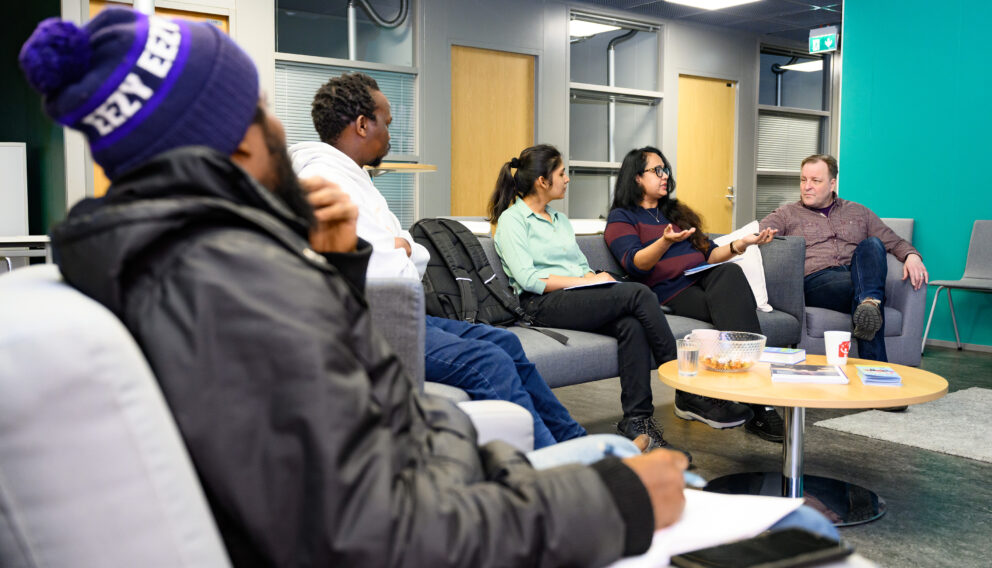
In the photo, from the left: Michael Junior Aguiyi, Michael Okot, Pooja Paramesha, Meria Sinoj ja Kimmo Solehmainen.
Development Manager Kimmo Solehmainen joined the mentoring programme out of curiosity and a desire to help. The experience has been rewarding and has also raised difficult questions about the employment of international talent in Finland.
Kimmo Solehmainen, Development Manager of the Kuopio Health community, became interested in mentoring through cooperation.
“The university is one of our most important partners, and we have become familiar with the Talent Hub Eastern Finland activities through working groups. When we were asked to join the mentoring programme, we wanted to support these activities”, Kimmo says.
The decision to join was also personal.
“I had not been involved in mentoring before. I wanted to get to know international students and see if I could help them.”
No big goals were set.
“The idea was mainly to do our part.”
Mentoring is a conversation – and sometimes dinner at home
The mentoring started with a kick-off event organised by the Talent Hub network, where the group got to know each other and agreed on common themes. Kimmo’s group consists of international students in the field of health.
The topics of the meetings were planned to be identifying one’s own strengths, career planning and networking. However, the plans have been modified along the way according to the participants’ interests.
“On one occasion, I presented companies in the health sector, because students were interested in it from the perspective of employment. On the second occasion, we discussed artificial intelligence and its utilisation.”
Mentoring is not limited to formal meetings.
“I also invited the students to dinner at my home. They got to meet my family and taste Finnish food – pikeperch breaded in rye flour and mashed potatoes. It was a completely new experience for many, but they liked it.”
Kimmo emphasises the importance of discussion.
“I try to talk as little as possible, and the group discusses as much as possible.”
One of the biggest surprises has been the students’ skills.
“They are very professional, even though they are students. Many of them have a strong background in their home country, for example, as entrepreneurs or in a hospital environment.”
Participation is not a given for them.
“They have taken big risks to study in Europe.”
At the same time, mentoring has brought up a difficult question.
”The number one goal of students is to find a job, but the purpose of mentoring is not to directly employ people. And now, the job market isn’t really moving. I have wrestled with this conflict between expectations and reality as a mentor.”
Cultural differences surprisingly small
Internationality has been a key part of the experience, but perhaps not in the way expected.
“It has been surprising how easy communication has been. We are united by the language and science of the health sector, so the cultural differences have remained quite small.”
Instead, mentoring has helped to put one’s own culture into words.
“When you explain Finnish working life and mentality to outsiders, you have to think about why we act in a certain way.”
The benefit is not always measurable, but it is significant
For an organisation, the benefits of mentoring may not be directly measurable.
“This may not be of direct numerical benefit to us, but networking is important. The students will get to know Kuopio Health and its network better.”
Kimmo also sees a broader societal perspective.
“The students who come here are brave. Some of them could end up becoming entrepreneurs in Finland, which would be a great opportunity for us.”
At the same time, the situation raises concerns.
“It’s sad to hear how much they have invested in coming here and how difficult it can be to find employment.”
Mentoring requires time and genuine interest
Kimmo recommends mentoring, but not for everyone.
“This takes time and commitment. There is no point in getting involved if you are already overloaded.”
However, for a real person, the experience is rewarding.
“I recommend this to a person who is interested in internationality, getting to know people and thinking about working life issues. The most important thing is not to perform, but to be able to listen and ask questions.”
One practical tip stands out above the rest:
“Find a sparring buddy to plan mentoring – it can be a colleague or even artificial intelligence.”
The future depends on one thing
Kimmo is cautiously open to continuing the mentoring.
“We will participate in the future, if possible. But I feel a conflict between the students’ expectations and reality. That also makes this difficult.”
However, the programme itself is praised.
“This has been carried out in a very professional manner. In the end, however, it is a matter of fact that this kind of activity needs to be supported by a well-functioning labour market.”
If you are interested in the opportunity to act as a mentor, you can find more information at: https://www.talenthubeasternfinland.fi/for-employers/?lang=en
Mentoring is part of the Talent Hub Eastern Finland network’s activities, which aims to promote the employment of international students in Eastern Finland. The network includes the University of Eastern Finland, Karelia, Savonia, Riveria, Sakky and YSAO. The project is co-funded by the European Union.
Text: Tiina Weman
Photos: Raija Törrönen